AI Detector
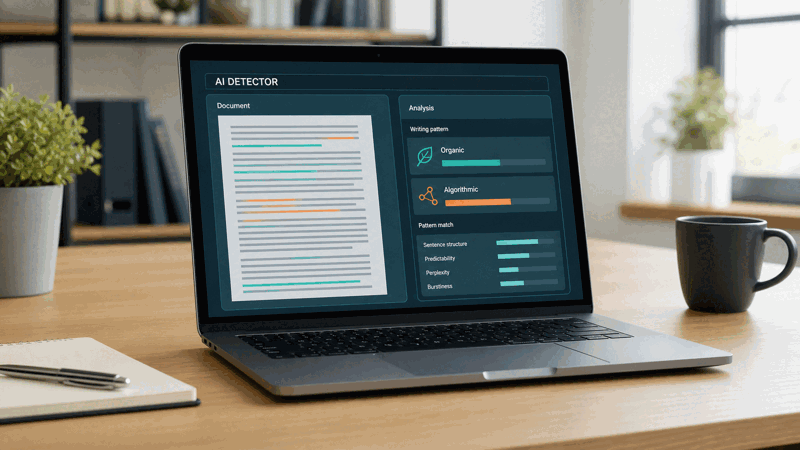
Get a rough heuristic estimate of whether text may be AI-generated. A guide only, not a definitive verdict. No signup, any device.
| Words | 0 |
| Sentences | 0 |
| Average Sentence Length (words) | — |
| Sentence-Length Variation (burstiness) | — |
| Vocabulary Diversity | — |
| Most-Repeated Phrase Count | 0 |
Higher sentence-length variation and higher vocabulary diversity are more typical of human writing; very uniform sentences and heavy repetition are more typical of some AI output — but both humans and AI produce text across this whole range, so these signals overlap heavily and are not decisive.
Share on Social Media:
This AI detector gives a rough estimate of whether a piece of text may be AI-generated, directly in your browser. Paste your text to see an estimate. It is a heuristic guide only, not a definitive verdict, and should never be used on its own to accuse anyone or make a decision about a person.
How to Use the AI Detector Step by Step
- Paste your text. Paste the text you want to check into the input box. A longer passage gives the estimate more to work with than a short one.
- Run the check. The tool analyses the text against simple heuristics and produces a rough estimate of how AI-like it appears.
- Read the estimate. The result is shown as a rough likelihood, indicating whether the text leans towards looking AI-generated or human-written.
- Treat it as a guide only. Read the estimate as one weak signal, never as proof. It can be wrong in both directions, so do not rely on it alone.
- Never use it to accuse. Do not use the estimate on its own to accuse a person, mark work, or make any decision about someone. It is not reliable enough for that.

What the AI Detector Does and Its Limits
An AI detector tries to estimate whether text was written by a person or produced by an AI language model. This tool does so with simple heuristics, looking at surface patterns in the writing, and returns a rough estimate. It is important to understand from the outset that this is a weak, approximate signal, not a reliable test.
AI detection is genuinely hard and no detector is reliable. Detectors produce both false positives, flagging human writing as AI, and false negatives, missing AI writing. Human writing that is plain or formulaic can look AI-like, and AI writing can easily be edited to look human. Because of this, results from any AI detector, including this one, should be treated with great caution.
This means the estimate is best used as a rough, informal prompt for your own judgement, not as evidence. It can never prove that a specific person did or did not use AI. Using such an estimate to accuse someone, to grade or penalise work, or to make any decision about a person would be unfair and unsound, given how often detectors are wrong.
Everything runs in your browser, so your text is never uploaded and the estimate appears privately on your device. The tool works on any device with no account, but its value is limited to satisfying curiosity and prompting a closer look, always alongside context and judgement rather than in place of them.
An Estimate Versus Proof
| Aspect | What the tool gives | How to read it |
|---|---|---|
| Estimate | A rough AI-likelihood | A weak signal, not a verdict |
| False positives | Human text flagged as AI | Common, so be cautious |
| False negatives | AI text seen as human | Also common |
| Proper use | Curiosity and a prompt to look closer | Never for accusing or deciding |
Who Uses an AI Detector
Pro Tips for Using the Estimate Responsibly
Common AI Detector Mistakes to Avoid
Related Tools You May Need Next
To understand a text objectively, our Text Readability Score Calculator and Text Complexity Analyzer describe its style, and the Plagiarism Checker checks text against the web.

Frequently Asked Questions
How does the AI detector work?
It analyses your text against simple heuristics, looking at surface patterns in the writing, and returns a rough estimate of how AI-like it appears. This is a weak, approximate signal, not a reliable test. AI detection is genuinely difficult, and this tool, like all detectors, is often wrong, so the estimate should be read only as an informal, non-authoritative guide, never as proof of how a text was written.
Is the AI detector accurate?
No AI detector is reliable, and this one is no exception. Detectors produce both false positives, flagging human writing as AI, and false negatives, missing AI writing. Human writing that is plain can look AI-like, and AI writing can be edited to look human. Because of this, the estimate is best treated as a rough, weak signal for curiosity, not as an accurate or trustworthy measure.
Can I use it to prove someone used AI?
No. You should never use this tool, or any AI detector, to prove that a person used AI or to accuse or penalise them. Detectors are far too unreliable for that, and doing so can be seriously unfair given how often they are wrong. The estimate cannot prove who or what wrote a specific text. If you have concerns, an open conversation and the wider context are far more reliable and fair.
Why do AI detectors give false results?
AI writing and human writing overlap a great deal, so no simple test cleanly separates them. Plain or formulaic human writing shares features with AI writing and gets flagged, while AI writing can be lightly edited to look human. This is why detectors produce both false positives and false negatives, and why their results, including this tool's estimate, should be treated with great caution.
What should I use the estimate for?
At most, treat it as a weak, informal signal to satisfy curiosity or prompt a closer, human look, always alongside context and judgement. For example, a writer might use it to check whether their own text reads as generic. It is not suitable for grading, accusing, or making any decision about a person, because it is not reliable enough to bear that weight.
Is my text uploaded anywhere?
No. The check happens entirely in your browser, so your text is never sent to a server. The estimate appears on your own device, and nothing you paste leaves it. This keeps the tool private, though its private nature does not make the estimate any more reliable; it remains a rough guide to be read with caution.
Can I use it on my phone?
Yes. The tool runs in your browser and works the same on a phone, tablet or computer, with no app to install. Paste your text and the estimate appears. Because everything runs on your device, it is private on mobile as on desktop, but the same limits apply: the result is a weak estimate, never proof, and should never be used to accuse or decide.
Is the AI detector free?
Yes, it is completely free with no account and no limit. You can check as much text as you like, at no cost. The tool runs in your browser, so there is nothing to install. Remember that being free and easy to use does not make the estimate reliable: it is a rough heuristic guide only, and should be read with caution and never used to make decisions about a person.