Chicago Title Capitalization
Convert your titles and headings to Chicago-style title case instantly as you type, ready to copy. No signup, works on any device.
Share on Social Media:
This Chicago capitalization tool converts your text to Chicago-style title case as you type, directly in your browser, ready to copy. Paste or write a title on the left and see it capitalised on the right. No account, no install, so you can title-case text on any device in seconds.
How to Capitalise a Title in Chicago Style
- Type or paste your title. Enter your title or heading in the input box on the left. The capitalised version builds as you type.
- See the title case result. The right side shows your text in Chicago-style title case, with the right words capitalised and the minor words lowercased.
- Check the capitalisation. Review the result to confirm the important words are capitalised and short words like articles and prepositions are lower case where the style expects.
- Tap Copy. Tap the Copy button to put the capitalised title on your clipboard, ready to use.
- Paste your title in place. Paste the title into your heading, document or citation wherever you need it in proper title case.
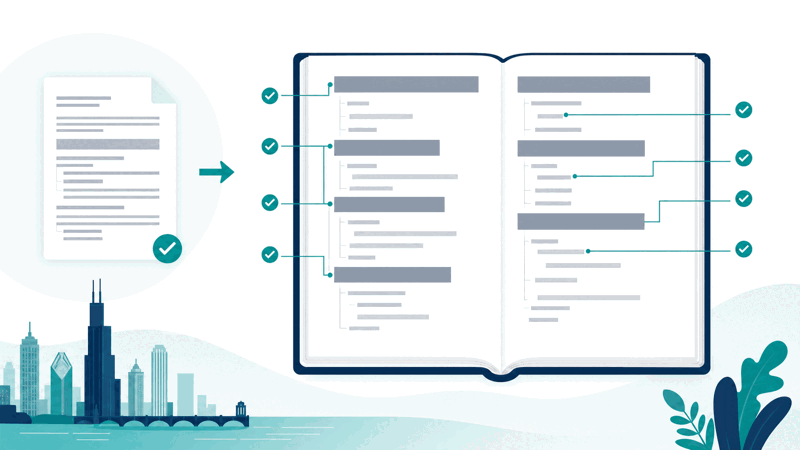
What Chicago Title Case Is and How It Works
The Chicago capitalization tool converts your text to title case following Chicago style. Chicago style capitalises the major words of a title and lowercases articles, coordinating conjunctions and prepositions regardless of length. You type your title once, and the tool applies these rules live, showing the correctly capitalised version beside your input.
In Chicago style, articles such as a, an and the, coordinating conjunctions like and, but and or, and prepositions of any length, such as through, between and with, are left lower case. The first and last words of a title are always capitalised, whatever they are, so the title reads correctly at its start and end. The tool applies these conventions automatically as you type.
Title case matters because headings, titles and citations look inconsistent when capitalised by hand, and different style guides have different rules. Using a tool built for Chicago style keeps your titles consistent with that guide, without you having to remember every rule.
Everything runs in your browser, so your text is never uploaded and the result appears instantly and privately. The tool works the same on a phone, tablet or computer, with no account and no limit on how many titles you can capitalise.
Chicago Style Versus Other Title Case
| Word type | In a title | Example words |
|---|---|---|
| Major words | Capitalised | Nouns, verbs, adjectives |
| Articles | Usually lower case | a, an, the |
| Short conjunctions | Usually lower case | and, but, or |
| First and last word | Always capitalised | Whatever they are |
Who Uses a Title Capitalization Tool

Pro Tips for Chicago Title Case
Common Chicago Capitalization Mistakes to Avoid
Related Tools You May Need Next
our AP and APA capitalization tools follow those styles, and the MLA tool follows MLA style.
Frequently Asked Questions
How do I capitalise a title in Chicago style?
Type or paste your title in the input box and the Chicago-style title case version appears on the right, updating live as you type. The tool capitalises the major words and lowercases minor words like articles and short conjunctions, while always capitalising the first and last word. Tap Copy to take the result, then paste it into your heading, document or citation.
What is Chicago title case?
Chicago title case is a set of rules for capitalising titles and headings. Chicago style capitalises the major words of a title and lowercases articles, coordinating conjunctions and prepositions regardless of length. articles such as a, an and the, coordinating conjunctions like and, but and or, and prepositions of any length, such as through, between and with, are left lower case. The first and last words are always capitalised. This tool applies those rules automatically, so your titles follow Chicago style without you having to remember each convention.
Which words are left lower case?
In Chicago style, articles such as a, an and the, coordinating conjunctions like and, but and or, and prepositions of any length, such as through, between and with, are left lower case. These are the small words that title case conventionally leaves lower case, unless one falls as the first or last word of the title, in which case it is capitalised. Major words such as nouns, verbs and adjectives are capitalised throughout.
How is Chicago different from other styles?
Style guides differ mainly in which minor words they lowercase and in length thresholds for prepositions. Chicago has its own conventions, which this tool follows. If your work needs a different guide, its capitalisation may differ slightly, so it is worth using the tool that matches your required style.
Does it capitalise the first and last word?
Yes. Whatever the first and last words of your title are, including small words like articles or prepositions, the tool capitalises them, since title case always capitalises the opening and closing words. Only minor words in the middle of the title are left lower case, following the style's rules.
Is my text uploaded anywhere?
No. The conversion happens entirely in your browser, so your title is never sent to a server. The result appears the instant you type, and nothing you write leaves your device, so you can capitalise titles privately on your own device.
Can I use it on my phone?
Yes. The tool runs in your browser and works the same on a phone, tablet or computer, with no app to install. Type or paste your title, see the capitalised version and tap Copy. Because everything runs on your device, it is just as fast and private on mobile as on desktop.
Is the Chicago capitalization tool free?
Yes, it is completely free with no account and no limit. You can capitalise as many titles as you like, on any device, at no cost. The tool runs in your browser, so there is nothing to install, and the Chicago-style title case result appears instantly as you type, with a Copy button ready when you are.